
 Dating and relationship patterns for individuals are the unconscious, repeating cycles of attraction, relating, and conflict that persist across different partners and relationships: driven not by chance, but by the internal architecture of the mind. Most people experience these patterns as external phenomena, when the mechanism is almost entirely internal. Therapy24x7 observes that these cycles often stem from early developmental experiences that shape adult expectations of intimacy.
Table of Contents
Dating and relationship patterns for individuals are the unconscious, repeating cycles of attraction, relating, and conflict that persist across different partners and relationships: driven not by chance, but by the internal architecture of the mind. Most people experience these patterns as external phenomena, when the mechanism is almost entirely internal. Therapy24x7 observes that these cycles often stem from early developmental experiences that shape adult expectations of intimacy.
Table of Contents
- The Architecture of Dating and Relationship Patterns for Individuals
- Attachment Theory and Dating and Relationship Patterns for Individuals
- Common Dating and Relationship Patterns for Individuals in Clinical Practice
- Clinical Case Studies: The Internal World in Practice
- Psychotherapy for Dating and Relationship Patterns for Individuals
- Frequently Asked Questions
- Conclusion
The Architecture of Dating and Relationship Patterns for Individuals
The concept of repetition compulsion suggests that individuals are unconsciously driven to reenact unresolved experiences from their past. In the context of dating and relationship patterns for individuals, this manifests as a magnetic pull toward partners who possess the same emotional limitations as early caregivers. While consciously seeking happiness, the unconscious mind seeks familiarity because it offers a sense of psychological safety. The “rules” of the engagement are known, even if they are ultimately destructive to the individual’s well-being. These behaviors are often ego-syntonic, meaning they feel consistent with the individual’s self-image and internal narrative. A high-achieving professional might view their tendency to “fix” a partner not as an unhealthy pattern, but as a testament to their competency and loyalty. However, beneath this narrative lies a structural drive to master a past situation where they were unable to secure the love they required. Therapy24x7 identifies these drivers as the primary obstacles to achieving long-term relational stability. According to Scientific research on adult attachment relationships, these patterns become entrenched because they are neurobiologically reinforced over time. When an individual encounters a partner who triggers their specific relational “wound,” the resulting emotional intensity is often mistaken for chemistry. In reality, it is the psyche recognizing an opportunity to repeat an old story in hopes of a different ending. For those seeking to move beyond these cycles, More info about dating counseling provides a framework for identifying these unconscious drivers. Relational blueprints are formed long before an individual enters the dating market and act as a psychological script. Research indicates that the landscape of modern commitment is shifting, with data showing that 25% of 40-year-olds in the U.S. have never been married. This record high reflects both changing social norms and the increasing complexity of modern intimacy. Understanding these Dating relationship patterns cheat sheet dynamics is essential for anyone who feels they are falling in love with the same person in a different package. Repetition occurs because the internal world prioritizes consistency over health in most interpersonal interactions. If an individual grew up in an environment where love was conditional, they may unconsciously seek out partners who are emotionally unavailable. This is not a lack of intelligence, but a manifestation of the internal working model: a mental representation of how relationships function. Therapy24x7 focuses on dismantling these models to allow for new, healthier ways of relating to others.
If one of these patterns feels like yours, our dating therapy in NYC page describes the weekly work of changing it.
Attachment Theory and Dating and Relationship Patterns for Individuals
Attachment theory provides the scientific foundation for understanding dating and relationship patterns for individuals in adult life. Developed by John Bowlby and Mary Ainsworth, it posits that the bond between an infant and their primary caregiver creates a template for all future intimacy. This template dictates how an individual perceives their own worthiness of love and the reliability of others. Approximately 50% of the population possesses a secure attachment style, while the remainder falls into insecure categories. Research on caregiver touch and neurodevelopment suggests that these patterns are physically wired into the brain’s stress-response systems. When a partner pulls away, an anxiously attached individual may experience a physiological panic that mirrors early childhood neglect. Inside an ongoing relationship this often shows up as anxiety in the relationship itself: the checking, the rereading, the fear of the next silence. Conversely, an avoidant individual may feel smothered by a partner’s request for connection, triggering a defensive shutdown. For residents in high-pressure environments, Dating attachment issues therapy NYC focuses on how these early models intersect with the demands of a professional life. Core beliefs are the architects of relational dynamics and often operate entirely outside of conscious awareness. If a person believes they are only valuable when they are productive, they will likely attract partners who exploit their labor. These Relationship dynamics and the family life cycle studies show that patterns are often multi-generational and passed down through family systems. Individuals do not just choose partners; they choose relational homes that feel familiar to their internal world. Statistics highlight the consequences of unrecognized patterns, as nearly half of women report that a partner has been unfaithful. This figure rises to over 60% among Black women, reflecting complex intersections of social and relational stress. While infidelity is a choice made by the partner, the choice to remain in a relationship where trust is chronically absent often points back to an internal model. Exploring the Category: Dating archives at Therapy24x7 reveals how these core beliefs can be dismantled through deep work.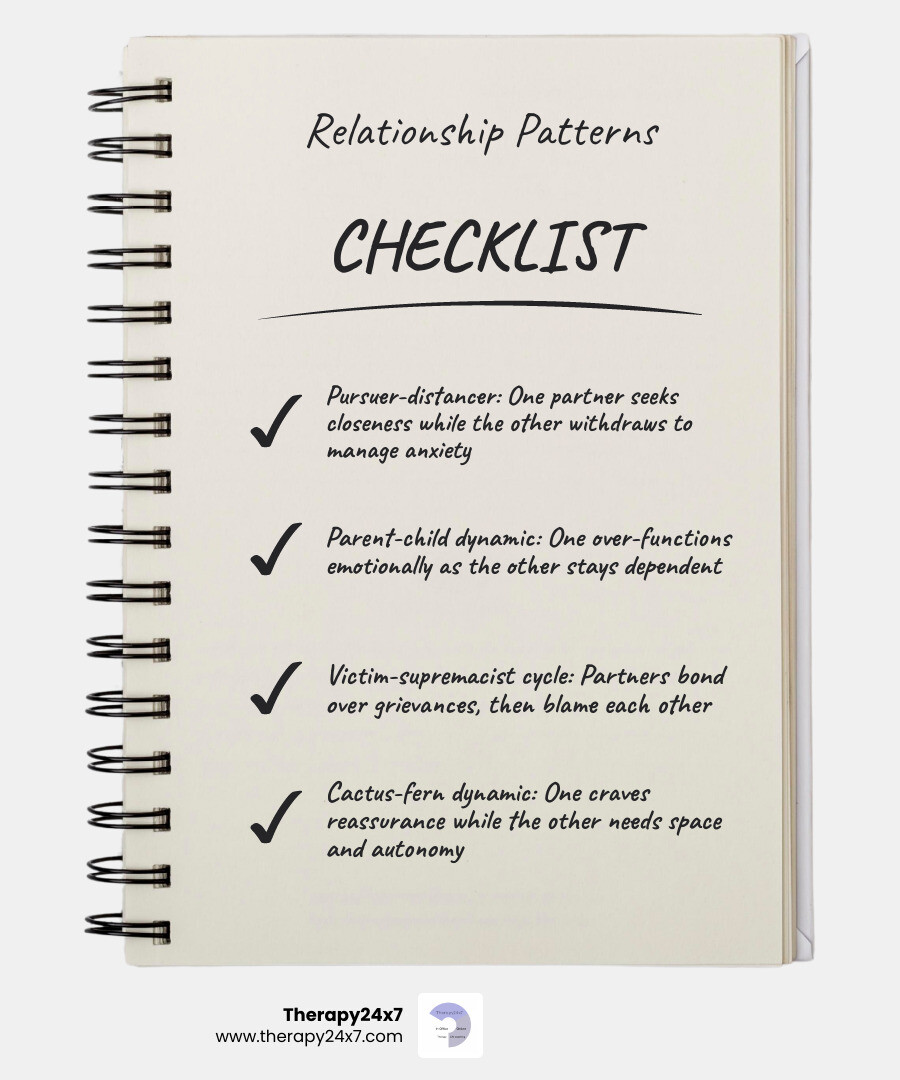 Insecure attachment styles often lead to a cycle of self-fulfilling prophecies in the dating market. An individual who fears abandonment may act in ways that inadvertently push a partner away, confirming their original fear. This reinforcement makes the pattern harder to break without clinical intervention and insight. Therapy24x7 aims to move individuals toward earned security by addressing these deep-seated fears and behaviors.
Common Dating and Relationship Patterns for Individuals in Clinical Practice
Relational dynamics are the habitual ways in which two people interact and often become a closed loop. In many cases, these interactions become a cycle where each person’s reaction triggers the other’s defense mechanism. The pursuer-distancer dynamic is perhaps the most common, where one partner seeks closeness while the other withdraws to regulate anxiety. This creates a feedback loop where the pursuer chases harder and the distancer withdraws further into isolation. Power in romantic relationships research suggests that these roles are often a defense against true vulnerability. By occupying a specific role, individuals avoid the threat of being seen as they truly are: flawed and human. The parent-child dynamic is also common among high-achieving professionals, where one partner takes on all emotional and logistical labor. This leads to significant burnout for the over-functioning partner and resentment for the dependent one. The victim-supremacist cycle involves partners bonding over mutual grievances or shared enemies before turning the dynamic on each other. One person eventually claims the moral high ground while the other feels perpetually persecuted and misunderstood. This dynamic prevents genuine intimacy because it relies on a power imbalance rather than mutual respect. Therapy24x7 identifies these dating and relationship patterns for individuals as barriers to authentic connection and emotional growth.
The Cactus-Fern dynamic serves as a useful metaphor for understanding the differing closeness needs of partners. One partner requires very little closeness and finds too much of it overwhelming, while the other requires constant hydration to survive. Neither individual is inherently wrong, but their interaction creates a cycle of starvation and drowning for both parties. Research indicates that 30% of single Americans are happy non-daters, often to avoid the repetitive stress of these unhealthy dynamics.
The victim-supremacist cycle involves partners bonding over mutual grievances or shared enemies before turning the dynamic on each other. One person eventually claims the moral high ground while the other feels perpetually persecuted and misunderstood. This dynamic prevents genuine intimacy because it relies on a power imbalance rather than mutual respect. Therapy24x7 identifies these dating and relationship patterns for individuals as barriers to authentic connection and emotional growth.
The Cactus-Fern dynamic serves as a useful metaphor for understanding the differing closeness needs of partners. One partner requires very little closeness and finds too much of it overwhelming, while the other requires constant hydration to survive. Neither individual is inherently wrong, but their interaction creates a cycle of starvation and drowning for both parties. Research indicates that 30% of single Americans are happy non-daters, often to avoid the repetitive stress of these unhealthy dynamics.
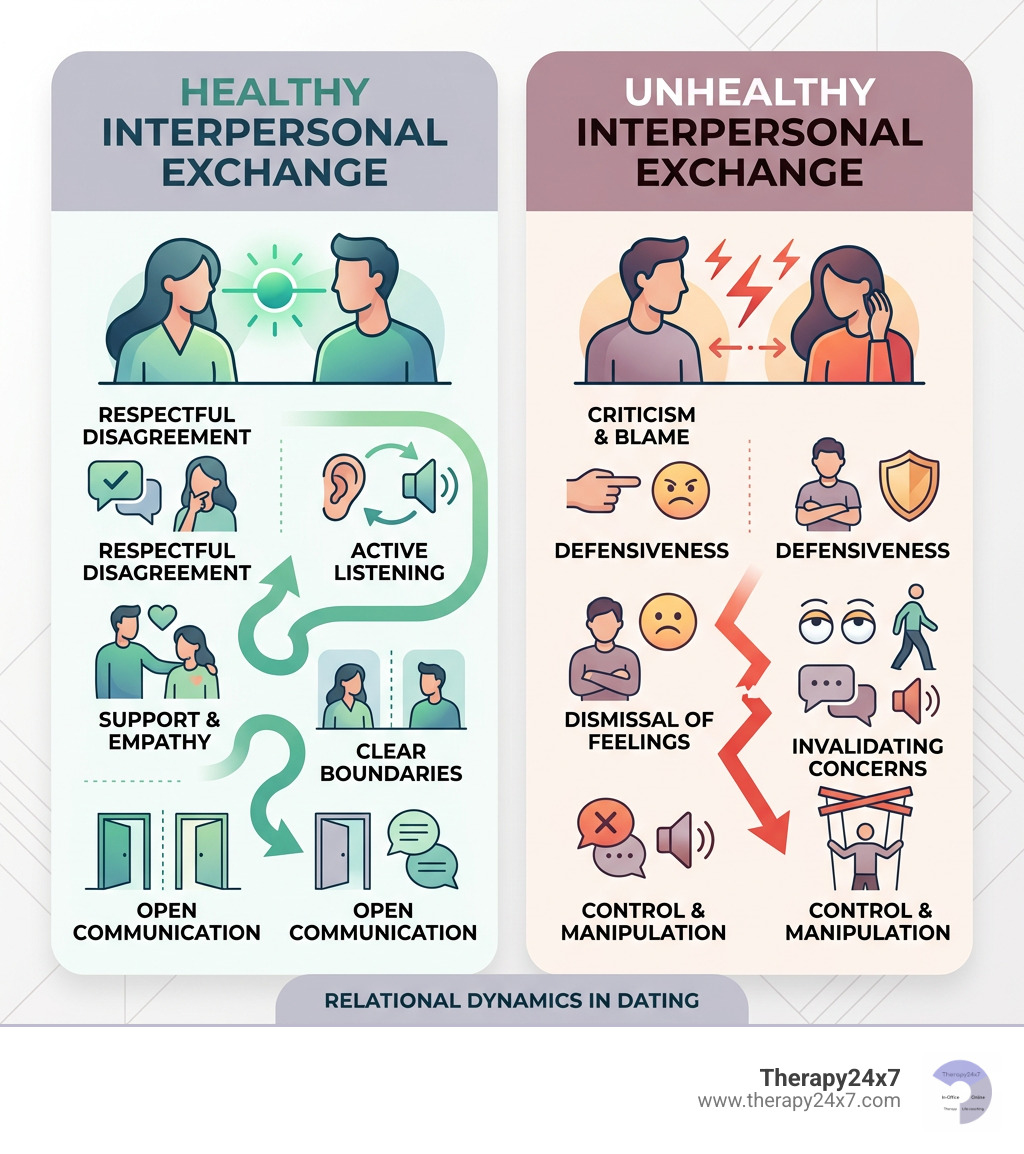 Conflict avoidance is another pattern where difficult topics are never broached, leading to a hollowed-out relationship. Intimacy is replaced by polite distance, and unresolved tension accumulates beneath a surface of false harmony. This eventually leads to a sudden collapse of the relationship when the emotional weight becomes too much to bear. Therapy24x7 works to help individuals recognize these patterns before they lead to total relational failure.
If one of these patterns is yours, naming it is the first half of the work. A free 15-minute matching call with our care team is the second.
Clinical Case Studies: The Internal World in Practice
At the Therapy24x7 Midtown Manhattan practice in NYC, the focus is on high-achieving professionals who find that success does not translate to intimacy. These individuals often possess an achievement identity that masks deep-seated relational insecurities and fears. By exploring the internal world, clinicians can help clients understand why they are drawn to specific partners. The following case studies illustrate how dating and relationship patterns for individuals manifest in a clinical setting.
Case Study 1: The Executive and the Avoidant Partner
Mark, a 38-year-old hedge fund manager, sought therapy because he was exhausted by the dating market. He consistently found himself attracted to women who were mysterious and independent, only to feel abandoned later. Through psychodynamic exploration, it was uncovered that Mark’s mother was a prominent surgeon who was frequently absent and emotionally reserved. Mark had learned that the only way to get her attention was to be exceptional in every way. In his adult life, he was unconsciously seeking out elusive women to finally win the validation he never received as a child. His attraction to unavailability was a repetition of his earliest struggle with his primary caregiver. By recognizing the Are you struggling with work relationships link, Mark began to understand that his type was actually a trigger. This insight allowed him to begin choosing partners based on availability rather than the familiar thrill of the chase.Case Study 2: The Caretaker and the Identity Crisis of Infertility
Sarah, a 41-year-old corporate attorney, was trapped in a caretaker-dependent dynamic with her partner. She managed all finances, social schedules, and emotional labor while her partner remained passive. When the couple began facing the identity crisis of infertility, Sarah’s over-functioning reached a breaking point. The unconscious grief of infertility stripped away her ability to fix the situation, leaving her feeling powerless. In therapy, she discovered that her role as a caretaker was a defense mechanism developed in a home with an alcoholic parent. By taking care of everyone else, she avoided the danger of her own unmet emotional needs. Her partner’s dependency was a role she had unconsciously auditioned him for to maintain her sense of control. Addressing the Category: Breakup of this old identity allowed her to begin relating from a place of authenticity.Psychotherapy for Dating and Relationship Patterns for Individuals
Therapy24x7 focuses on long-term structural change by exploring the internal world of the individual. Insight-oriented psychotherapy is a Socratic process that aims to bring the unconscious into the light of awareness. This work involves noticing transference, where the client projects feelings about early caregivers onto the therapist. These projections provide valuable data about the client’s interpersonal impact and their expectations of others. Countertransference is another critical tool, representing the therapist’s emotional response to the client during the session. This response helps the clinician understand the subtle ways the client may be pushing others away or inviting dependency. A Psychodynamic study on relationship quality found that individuals who gain insight into their patterns report higher levels of satisfaction. This is because the change is internal, and they are no longer at the mercy of their triggers. The process also addresses the unconscious grief of life transitions, acknowledging the deaths of old versions of the self. Major life shifts often reactivate old dating and relationship patterns for individuals, requiring a deeper level of exploration. For those ready to begin this work, Ads: Dating therapy provides a pathway to deeper connection. The goal is to move from a reactive state to an intentional one in all relationships. Breaking these cycles requires more than just choosing differently; it requires shifting the internal architecture of the mind. This is the core of Dating and relationship patterns for individuals work at Therapy24x7. When the internal world changes, the external radar for partners also shifts toward healthier options. Individuals become less magnetized by unavailability and more curious about stability and emotional depth.You do not need your pattern named perfectly before reaching out. Start with a free 15-minute call and we will help you find the words.
Frequently Asked Questions about Relationship Patterns
Why do I keep attracting the same type of partner?
This is rarely about the other person and almost always about unconscious familiarity within the individual’s mind. The psyche is drawn to people who fit internal working models established in early childhood. If an individual grew up with a critical parent, they may seek partners who require them to prove their worth. This is a form of repetition compulsion: an attempt to fix the original trauma by changing the outcome with a new person.How do childhood experiences influence adult dating?
Childhood experiences provide the blueprint for intimacy and dictate how individuals handle conflict and closeness. Attachment styles: whether secure, anxious, or avoidant: influence how much vulnerability a person can tolerate. These Family dynamics research findings show that individuals learn how to love by experiencing their first relationships. These early lessons are then carried into adulthood and applied to romantic partners.Can insight-oriented therapy change my relationship patterns?
Yes, but the goal is structural change rather than just behavioral modification or quick tips. By understanding the root causes of attractions and triggers, an individual can shift their internal world. When the internal world changes, the external radar for partners also changes significantly. Individuals stop being magnetized by unavailability and start becoming curious about health and stability in their romantic lives.Conclusion
Understanding dating and relationship patterns for individuals is the difference between being a passenger in life and becoming the architect of the future. For high-achieving professionals, these patterns are often the final frontier of self-mastery and emotional fulfillment. Success in the professional world requires grit and control, but success in the relational world requires insight and the courage to face the unconscious. Therapy24x7 provides a clinical environment for this deep work to take place. By moving away from skills-based approaches and toward psychodynamic exploration, individuals can break the cycles that have held them captive. The goal is not just to find a partner, but to find the self that is capable of a lasting, healthy connection. This process requires a commitment to exploring the internal world and the early experiences that shaped it. Therapy24x7 remains dedicated to helping individuals achieve this long-term structural change. Individuals who are ready to explore the root causes of their interpersonal dynamics can find support through clinical consultation. The process of Dating and relationship patterns for individuals work is a journey toward greater self-awareness and relational health. By addressing the internal architecture of the mind, it is possible to create a new future that is not a repetition of the past.Related reading: why you keep dating the same person.