

High Achievement or High Anxiety: The Case for Deep Psychotherapy
The Silent Cost of Success: Why High Achievers Need More Than Coping Skills
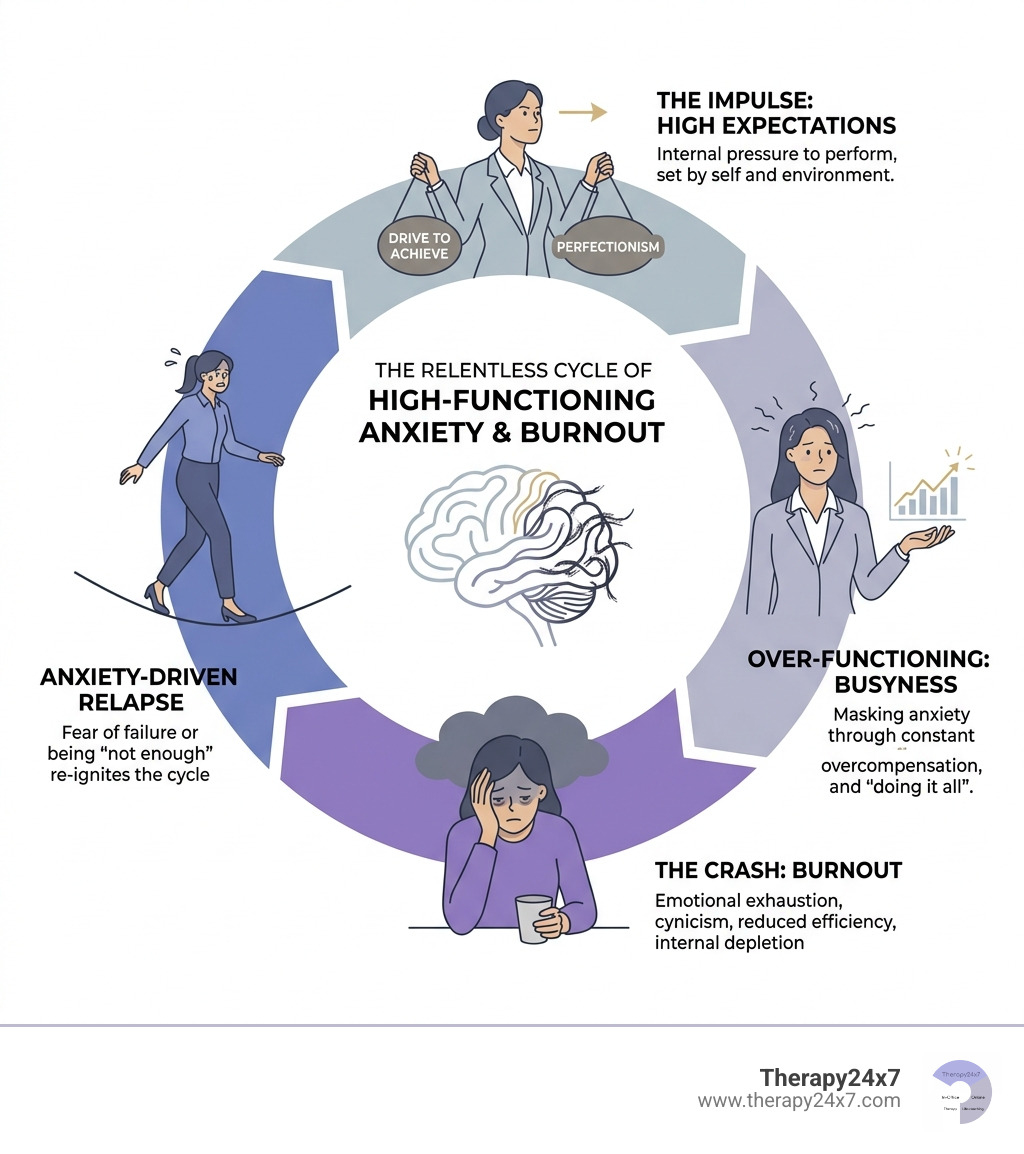
The goalposts keep moving. Every milestone is hit on schedule, the promotion, the closed deal, the external markers of a successful life, yet the anticipated feeling of arrival never quite takes hold. This is the work anxiety pattern that runs underneath high achievement. Instead, there is a low, persistent hum of dissatisfaction, which often sharpens around moments of performance and evaluation, a sense that stopping, even briefly, carries an unnamed danger. This internal pressure is not a productivity problem, but a profound disconnect between external achievement and internal depletion.
What is deep psychotherapy for high achievers? Some readers come here looking for practical ways to deal with work anxiety first. This article goes deeper. For the most common everyday surface this takes, see our piece on Sunday anxiety.
If the pattern here sounds familiar, our Anxiety Therapist NYC team works with it weekly, in person in Midtown and online across New York.
Deep psychotherapy for high achievers is an intensive, insight-oriented treatment. It examines the unconscious patterns and early relational templates driving perfectionism and burnout. Unlike symptom-focused approaches, it addresses the root causes of internal conflict to create lasting structural change in the personality. It is typically conducted at a higher frequency to maintain therapeutic intensity and continuity.
Research bears this out in stark terms. Students in high-achieving academic environments experience depression and anxiety at rates three to seven times higher than national averages, with perfectionism and achievement pressure identified as primary contributing factors. Depression rates among CEOs and senior corporate leaders are estimated at double the national average, and in some studies, as high as 50%. Yet this population is among the least likely to seek help, in part because success is routinely mistaken as evidence of psychological health.
What is deep psychotherapy for high achievers?
Deep psychotherapy for high achievers is a specialized, intensive form of psychodynamic therapy. It prioritizes the exploration of the internal world over the management of external behaviors. While standard interventions might focus on managing a symptom like procrastination, deep psychotherapy asks why the symptom exists as a defense in the first place.
The core tenets of this approach include:
- Unconscious Exploration: Identifying the hidden beliefs and desires that dictate behavior without the individual’s conscious awareness.
- Relational Dynamics: Examining how early interactions with caregivers created “templates” for modern professional and personal relationships.
- Structural Change: Aiming for a fundamental shift in the personality structure rather than just a temporary reduction in stress levels.
- Insight-Oriented Dialogue: Using a Socratic method to uncover the “why” behind the “what” of a high-achiever’s life.
This approach looks backward to move forward more authentically. It acknowledges that the very traits that fueled a professional’s rise, perfectionism, hyper-vigilance, and a relentless work ethic, are often the same traits causing internal erosion.
Why does success often feel like a silent burden?
Success feels like a burden when it is fueled by “achievement-contingent self-worth,” a psychological state where a person’s value is entirely dependent on their latest win. This creates a “golden cage” of expectations; the more one achieves, the higher the stakes become, and the more terrifying the prospect of a mistake feels.
According to the American Psychological Association, 79% of employees report chronic workplace stress, but for those in leadership, the effects are compounded by isolation. This “success isolation” occurs because high achievers often feel they cannot be vulnerable with peers (who are competitors) or subordinates (who rely on their strength). Consequently, they mask their struggles, leading to a profound sense of loneliness even in a crowded boardroom.
This internal pressure often manifests as work-related anxiety, where the professional is constantly scanning for threats to their status. When your identity is fused with your job title, a professional setback isn’t just a business problem, it is an existential crisis.
Signs you might relate to the high-achiever paradox
The “High-Achiever Paradox” describes the state of being externally powerful but internally fragile. A professional may function like a “machine” at the office while running on fumes behind closed doors. Identifying these patterns is the first step toward seeking generalized high-functioning anxiety support.
Signs of the paradox include:
- Functional Freeze: Getting work done while feeling emotionally numb or “locked in,” unable to truly relax or enjoy downtime.
- Sunday Night Dread: A visceral tightening in the chest or stomach that begins long before the work week actually starts.
- Productivity as a Defense: Using work to avoid dealing with difficult emotions, grief, or relational problems.
- The Imposter Narrative: A persistent fear that despite accolades, one is a “fraud” who will eventually be “found out.” This is a hallmark of imposter syndrome at work.
- Goalpost Shifting: The inability to celebrate a win because of immediate worry about the next milestone.
When overworking late at night occurs not out of necessity, but because it feels unsafe not working, achievement is likely being used as an emotional regulation strategy. This is an unsustainable cycle that deep psychotherapy is designed to interrupt.

Ready to talk through what is coming up for you?
Start with a 15-minute call →What causes the “never enough” internal narrative?
The “never enough” narrative is rarely about the work itself; it is usually rooted in early relational templates. For one update on the same theme, see Burnout Therapy for High-Achievers in Their 20s and 30s. In many high-achieving families, love and approval are “conditional”, granted when the child performs well and withdrawn (or replaced by criticism) when they do not. Over time, the child internalizes this voice, and it becomes the harsh inner critic of the adult professional.
Psychologically, this often leads to repetition compulsion, a phenomenon where individuals unconsciously recreate stressful situations from their past in an attempt to “master” them in the present. For example, a professional might choose a demanding, critical boss because that dynamic feels familiar and “safe,” even though it causes perfectionism and work anxiety.
Furthermore, the fear of evaluation at work is often an adult version of the fear of losing a parent’s approval. For an angle we returned to, see Cigna Therapy NYC: Copay Deductible Guide. When we explore these roots in therapy, we find that the relentless drive isn’t just about ambition, it’s about a fundamental need to feel “good enough” in the eyes of an internalized authority figure.
Case Study: The executive who could not stop
Marcus (name changed for privacy) was a 42-year-old partner at a prestigious Midtown Manhattan law firm. He sought therapy because he was experiencing work burnout and “unexplained” panic attacks. Externally, Marcus was at the top of his field. Internally, he lived in a state of chronic workplace hypervigilance, checking his email every few minutes, even during his daughter’s soccer games.
The Psychological Pattern: Marcus’s identity was completely fused with his role. He believed that if he stopped being the “best,” he would become “nothing.”
The Underlying Cause: Through deep psychodynamic exploration, Marcus realized that his father only showed him warmth when he brought home straight As. As an adult, he had unconsciously replaced his father with his firm’s senior partners. His panic attacks were a physiological protest against the “conditional approval” he was still trying to earn. For the newer take on this, see Relationship Burnout Therapy NYC: 30s Guide.
The Outcome: By addressing these unconscious patterns, Marcus moved toward internal steadiness. He didn’t lose his drive, but he stopped using it as a shield. He began to set boundaries, not as a “skill,” but because he no longer felt his existence depended on being 100% available to his clients.
How deep psychotherapy for high achievers addresses the root of perfectionism
Moving beyond surface-level interventions
Many professionals find that surface-level interventions or behavioral management techniques provide only temporary relief. These methods often fail high achievers because they do not address the internal world. If a deep-seated belief exists that one is fundamentally unworthy, behavioral reframing will not provide lasting relief.
Deep psychotherapy focuses on Long-Term Structural Change. The treatment examines work performance anxiety as a symptom of a deeper fracture in the self. By exploring these roots, the need for perfectionism naturally diminishes because the underlying anxiety is resolved, rather than just managed.
The identity crisis of infertility in high-performing women
For many high-achieving women, the collision of professional peak years and biological timelines creates a unique identity crisis. Infertility can feel like the first “failure” that cannot be outworked or out-smarted. This often triggers deep chronic depression and a sense of “unconscious grief.”
The approach to grief counseling in this context involves examining how infertility disrupts the “achievement identity.” The process helps women navigate the fragmentation of their self-image and find a path toward integration that is not solely defined by professional or maternal output.
Relational patterns and repetition compulsion in dating
High achievers often approach dating with an “efficiency” mindset. However, this often leads to selecting partners who are emotionally unavailable, mirroring the “conditional” dynamics of childhood. This is a focus of psychodynamic dating therapy for high achieving adults NYC.
By using dating counseling to explore attachment dynamics, professionals can break the cycle of choosing partners who reinforce their sense of isolation. The work examines why someone might be drawn to the chase but terrified of the actual intimacy that follows.
Want to test the fit before committing?
Let us match you to a clinician →Why is twice-weekly therapy recommended for deep work?
For deep, insight-oriented work, frequency is a catalyst. Meeting once a week often results in “reporting” on the week’s events, what happened at the office, a fight with a spouse, leaving little time for the deeper exploration of the unconscious. Twice-weekly therapy creates a “therapeutic container” that maintains the momentum of thought.
Benefits of increased frequency include:
- Accelerated Insight: Patterns emerge more clearly when the time between sessions is shorter.
- Continuity of Thought: You can pick up exactly where you left off, allowing for a deeper emotional “dive.”
- Greater Support for Intensity: Deep work can be challenging; knowing you will see your therapist again in a few days provides the safety needed to explore difficult memories or feelings.
- Stress Management: For those in high-pressure roles, the increased frequency acts as a vital stress management tool, preventing the accumulation of “micro-stressors” that lead to burnout.
Why deep psychotherapy for high achievers is essential for NYC professionals
Navigating the Midtown Manhattan pressure cooker
New York City, specifically Manhattan and Midtown, operates at a frequency unlike anywhere else in the world. In the finance, law, and tech sectors near Grand Central, there is an unspoken “cult of busyness.” In this environment, work anxiety isn’t just common; it’s often rewarded.
Deep psychotherapy provides a necessary counter-culture. It is a space where the “billable hour” doesn’t exist, and where you are seen as a human being rather than a high-performing asset. For professionals in Chelsea or the Upper West Side, having a dedicated space to “unmask” is essential for long-term psychological survival.
The unconscious grief of life transitions
High achievers often struggle with transitions because they involve a loss of the “striving self.” Whether it’s a promotion to a role that requires more leadership and less “doing,” a career pivot, or retirement, these shifts can trigger anxiety attacks.
We explore the overachievement driven by anxiety that often masks a fear of the future. By processing the “unconscious grief” of leaving behind an old version of oneself, professionals can move into new phases of life with meaning and purpose that isn’t tied to their previous resume.
Frequently Asked Questions about Deep Psychotherapy
What are the unique characteristics of deep psychotherapy?
Deep psychotherapy is distinct because it focuses on the internal world and unconscious patterns. While other therapies might provide “tools” to handle a panic attack, deep psychotherapy seeks to understand why the panic attack is happening in the first place. It is a relational, insight-oriented process that aims for structural change in the personality, leading to more authentic living.
Will therapy make me lose my competitive edge?
This is the most common fear high achievers have. The answer is a definitive no. In fact, deep psychotherapy often enhances performance. When you are no longer driven by frantic, unconscious anxiety, you can lead from a place of “internal steadiness.” You become more decisive, more creative, and more resilient because your self-worth is no longer on the line with every decision.
How long does it take to see results from insight-oriented work?
Deep structural change is a journey, not a sprint. While many clients feel a sense of relief within the first few weeks of being “seen” and “heard,” the work of dismantling long-standing unconscious patterns typically takes six months to several years. It is an investment in the “long-term” self, much like a long-term investment strategy in finance.
Conclusion
The pursuit of excellence does not have to come at the cost of internal peace. Therapy24x7 specializes in the deep, relational work required to help high achievers move beyond the “never enough” narrative. Whether navigating imposter syndrome at work or seeking a deeper understanding of relational patterns, the Midtown Manhattan and Grand Central area practices are designed to support this evolution.
True success is not just about what has been built; it is about who a person is when the work stops. By addressing the root causes of the drive, a life of long-term fulfillment and internal steadiness becomes possible.
Reviewed by Efrat Gotlib and NPI (1720225683)
Author Bio: Efrat Gotlib Efrat Gotlib, LCSW, is the founder and clinical director of Therapy24x7. With an NPI of 1720225683, she is a seasoned psychotherapist specializing in psychodynamic and insight-oriented treatment for high-achieving professionals in New York City. Having completed advanced training at the Metropolitan Institute for Training in Psychoanalytic Psychotherapy (MITPP), her practice focuses on helping executives, attorneys, and tech leaders navigate the complex intersections of achievement, identity, and mental health through deep, relational work. She is committed to providing a sophisticated, empathetic space for professionals to achieve long-term structural change.
For ongoing one-on-one work with a clinician on our New York team, see our weekly individual therapy in Manhattan page.
If the high-anxiety side of high achievement is what you recognize most, see weekly psychodynamic therapy for high-functioning anxiety for how the work runs.
Still figuring it out?
Talk to our team →More on anxiety: see generalized anxiety therapy for chronic, hard-to-control worry, and health anxiety therapy for the fear of being seriously ill.